The client
A wealth business that sells advice, one conversation at a time
The wealth-management arm of a private bank, where relationship managers advise clients on markets, funds and portfolios. Its growth depends on how often those managers talk to clients, and how well prepared they are when they do.
Most of an RM’s week, though, went into getting ready to talk rather than talking.
The challenge
Relationship managers doing research, design and admin
Every market view was hunted down by hand, every comparison deck was built by hand, and every meeting was written up by hand. Market insight alone took around nine hours a week. A portfolio comparison deck took three. Notes and follow-up emails took another 45 minutes per meeting.
Where the week went
When markets moved, there was no time to work out who was affected. The largest clients got a call. Everyone else waited.
Constraints
What we had to design around
- Scattered sourcesThe house view lived in CIO research PDFs, chat threads, email and shared drives. In the RMs’ own words, they had to go to different places to extract the information — and pulling it by hand was double work.
- One voiceA junior RM and a senior RM had to give a client the same view. The assistant had to speak the bank’s playbook, not improvise its own.
- ProofAdvice to wealth clients gets audited. Every number had to link back to the specific report it came from, so an auditor could trace it in under two minutes.
- Client privacyNo client personal data in the first release. The model had to stay contained within the information the bank gave it, with encryption, a consent toggle and a watch-list screen built in.
- GrowthThe first release sat apart from the core banking platform. The same engine had to take live client positions later — and other business lines after that — without being rewritten.
Our approach
Start from the RM’s day, not from the model
We mapped the RM’s week first, stage by stage, and put an hour figure on each one. Market insight, messaging, client prep, triage, meetings, follow-up and audit each became a job with its own measure: time to insight, deck-prep minutes, the share of meetings logged.
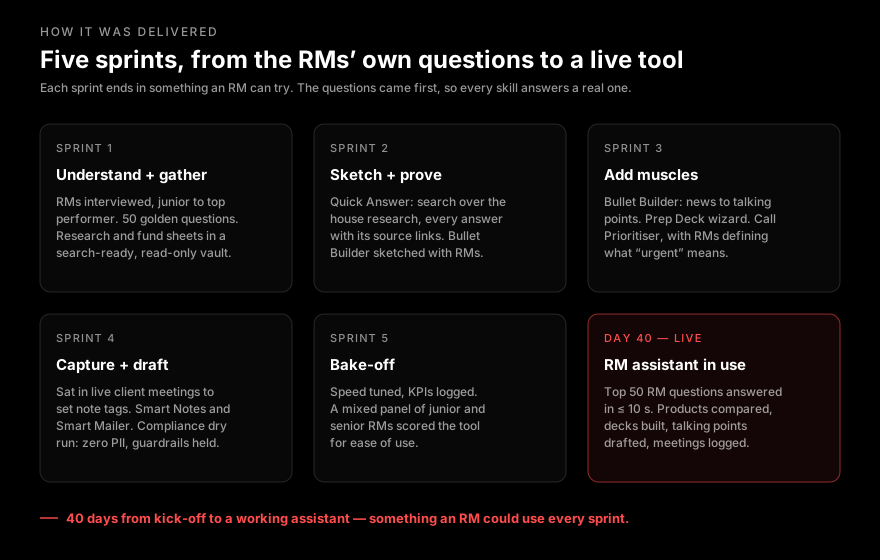
We then interviewed RMs from junior to top performer and collected the 50 questions they asked most. Those golden questions became the test set. A skill was finished when it answered real ones quickly, with sources an auditor would accept.
The solution
Six skills, one knowledge map, one place to ask
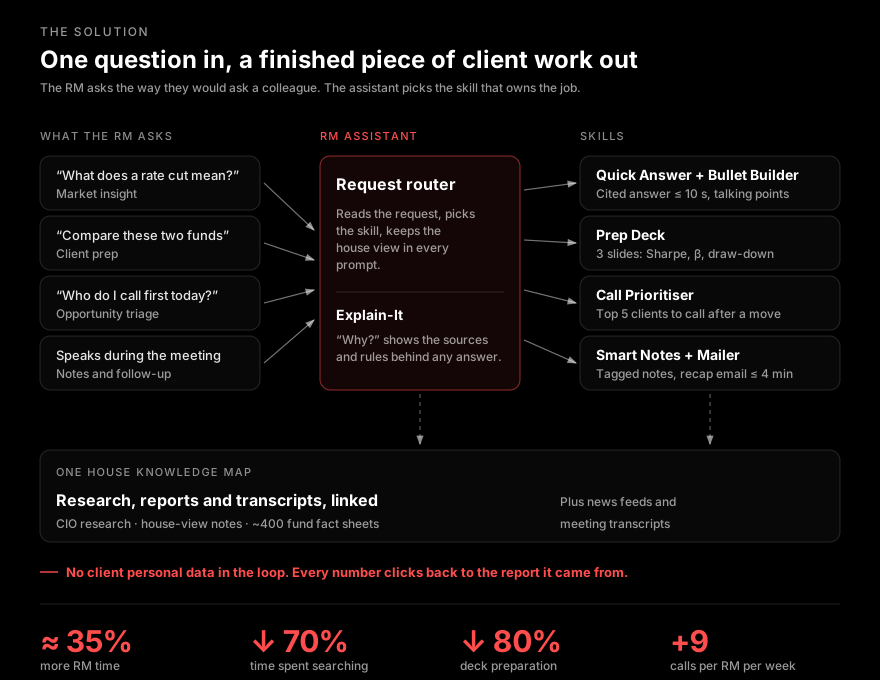
- Quick Answer — Ask any market or product question and get a house-approved answer with three source links. Hover-tips explain Sharpe, beta and the rest, so a junior RM can explain them as well as a senior one.
- Bullet Builder — One click turns overnight news and house-view notes into client-ready talking points, in the bank’s style.
- Prep Deck — Type two fund tickers and get a three-slide comparison — Sharpe ratio, beta, draw-down — drawn from around 400 fund fact sheets. The assistant writes a short “why this matters” note beside each chart.
- Call Prioritiser — After a market move, a daily list of the top five clients to call, with a script for each. Alerts are throttled to three a week so they stay worth reading.
- Smart Notes and Smart Mailer — The RM speaks; notes appear, with tasks and client interests tagged. One click drafts a bilingual recap with compliant phrasing and the disclaimer already in place.
- Explain-It — Click “Why?” on any answer to see the sources and the rules behind it. The same trail is what audit queries.
Responsible by design
Four rules for an assistant that talks to advisers
Ground
Answers come from the bank’s research, not the model’s memory.
A knowledge map links reports, house-view notes, fund sheets and transcripts, so an answer connects facts instead of guessing at them.
Cite
Every number clicks back to its source.
Each answer carries its source links, and Explain-It shows the rules applied. An audit-trail query takes under two minutes.
Contain
No client personal data in the loop.
Call ranking runs on a synthetic client table tagged only by sector and geography. Transcripts are redacted, and a compliance dry run confirmed zero personal data before release.
Stay on message
The house view is in every prompt.
Prompts embed the bank’s house-view rules and follow-up emails use approved phrasing, so a client hears one consistent view whichever RM they speak to.
The second rule is the one RMs asked for. A link to the report behind a number is what lets an RM repeat it to a client with confidence.
Results
What changed for the RMs
- About 35% more RM time — roughly 15 hours of a 45-hour week that used to go on searching, preparing and writing up now goes back to clients.
- 70% less time searching for market insight, with the top 50 RM questions answered in 10 seconds or less, each with its sources.
- 80% less deck preparation, from two tickers to a three-slide comparison and one-pager.
- 100% of meetings auto-logged, with a bilingual recap and action list out in four minutes or less — about 25 minutes of admin saved per call.
- Nine more proactive client calls per RM per week — about 450 a year — and 4–6% organic growth in assets under management per RM per year from more frequent contact and sharper talking points.
RMs stopped spending their mornings getting ready to call clients and started calling them.
Beyond the numbers
What else changes
Junior RMs sound like senior ones. Hover-tips on Sharpe and beta, the house view in every answer and approved phrasing in every email close the gap between a first-year RM and a seasoned one.
And because the engine reads whatever feeds it, live client positions are an addition, not a rebuild — turning the same skills into per-client briefs and data-driven alerts, and later opening them to other business lines.
If your advisers spend more time preparing than advising
The first question is where their hours go. That is answerable from a week of their own questions, before anything gets built.