The client
An insurer whose evidence arrives by phone camera
An insurer selling and servicing vehicle policies through digital channels. Before a policy is confirmed, the customer photographs the vehicle, films a walk-around and captures the VIN plate. Most of them also talk to the insurer through a Messenger chatbot.
Both channels worked. Neither scaled with the team behind them.
The challenge
A team checking photos one by one
Every submission was reviewed by hand — for quality, for completeness and against the policy. A blurry VIN, a missing angle or a dark video was only spotted when someone opened it, and then the customer had to start again.
What each submission needs
Meanwhile the chatbot handled scripted topics well and everything else poorly, so those questions also landed on people.
Constraints
What we had to design around
- EvidenceA photo is only useful if it is sharp, well lit, taken from the right angle and of the right thing. The system had to judge all four, and say why, not just return a pass or fail.
- VideoStill images were not enough. A walk-around video had to be checked for full 360-degree coverage, and a VIN close-up had to be legible enough to read.
- The policyA good photo of the wrong vehicle is still a failed check. Every submission had to be compared with the customer’s policy record, using the insurer’s own policies and rules as the source of truth.
- The customerFeedback that arrives after the customer has gone means another round trip. Quality had to be judged while they were still uploading.
- One front doorCustomers already talked to the insurer on Messenger, with a helpdesk behind it. The chatbot upgrade had to live there, not in a new app.
Our approach
Let the model look, let the policy decide
Vision-language models are now good at describing what is in a photo. They are not a source of truth about a customer’s policy. So we split the job in two.
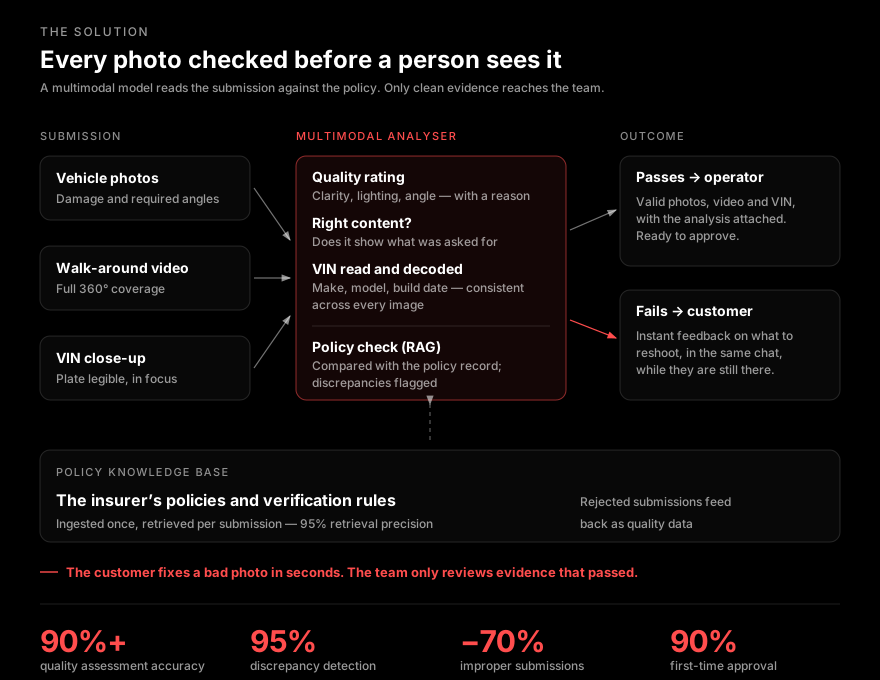
A multimodal model does the looking — quality, content, the VIN, consistency across shots — and writes down what it saw. Retrieval over the insurer’s own policies and rules does the comparing. And the verdict reaches the customer while they are still uploading, because the cheapest reshoot is the one that happens straight away.
The solution
From a phone camera to a verified submission
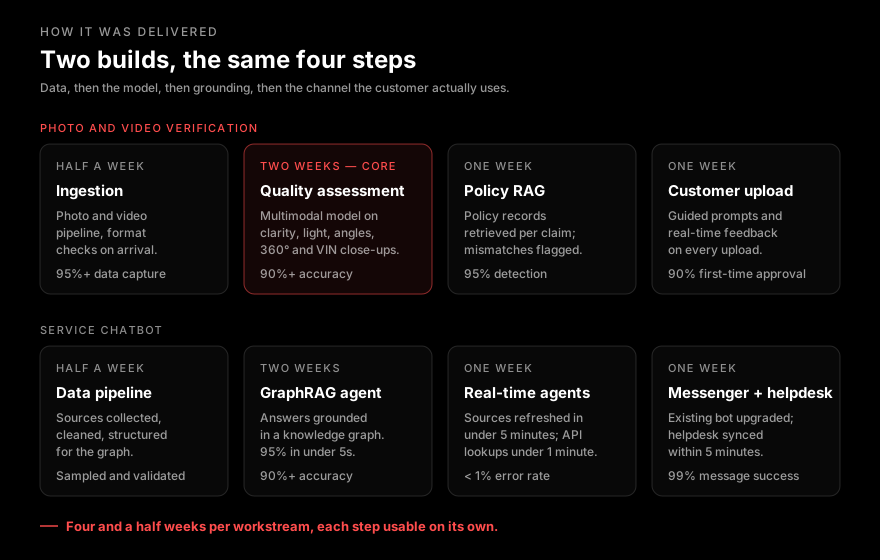
- Ingestion — A pipeline for vehicle photos and videos with format and quality validation on arrival, 95%+ data capture and secure storage at 99.9% availability.
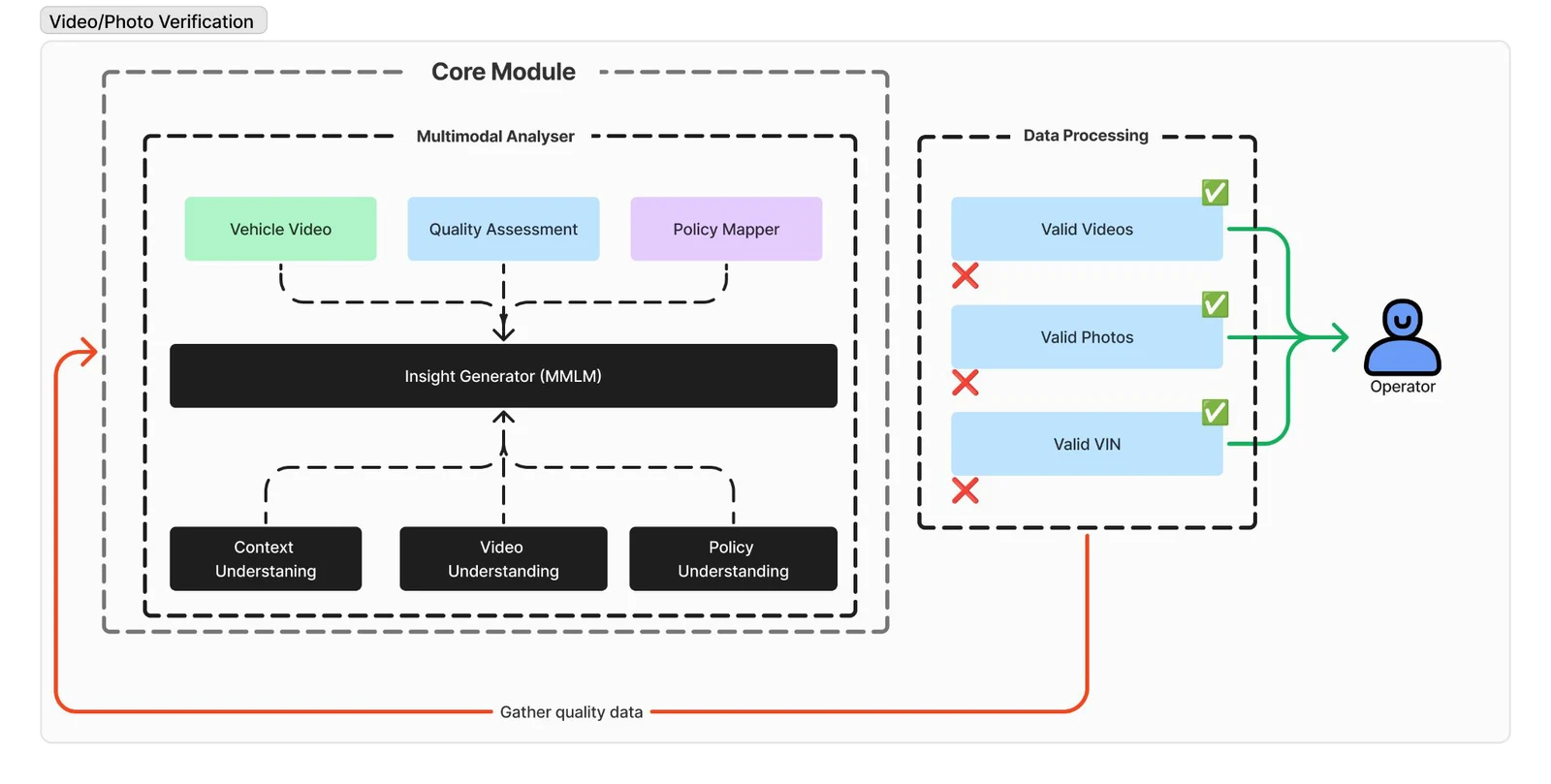
- Multimodal analyser — A vision-language foundation model rates each image and video for clarity, lighting and angle, with a written explanation. It confirms the shot shows what was requested, reads the VIN, decodes make, model and build date, and checks those details agree across every image.
- Policy retrieval — Retrieval-augmented generation over a knowledge base of the insurer’s policies and rules. Each submission is compared with the policy record and discrepancies are flagged for the operator.
- Customer interface — A chat-style upload flow with guided prompts. Customers see the quality verdict as they upload, and receive their policy details and documented damage report once verification is complete.
- Service chatbot — Behind the existing Messenger bot, a triage agent routes each question to a query-resolution agent working over a GraphRAG knowledge graph or a real-time data agent calling live APIs. A responding agent replies; guardrails, caching and feedback logs run in the background. Conversations sync with the helpdesk.
Responsible by design
Four rules for AI near a policy decision
Explain
Every rating carries a reason.
“Sharp, well lit, no blur” or “damage visible, no lighting issues”. An operator can see why a photo passed, and a customer can see why it did not.
Ground
Policy facts come from the policy record.
The model does not recall what a customer is covered for. It retrieves it from the insurer’s knowledge base, at 95% retrieval precision.
Escalate
The model checks; a person approves.
Valid photos, videos and VINs reach an operator with the analysis attached. Discrepancies with the policy are flagged, not decided.
Learn
Rejections become training signal.
Failed submissions feed back into the analyser as quality data, so the checks sharpen on the cases customers actually get wrong.
The third rule shapes the rest. The analyser does not approve policies. It makes sure that what an operator approves is complete, legible and consistent with the record.
Results
What changed for the verification team
- 90%+ accuracy on photo and video quality assessment — clarity, lighting, required angles, 360-degree coverage and VIN close-ups, each with a written explanation.
- 95% detection of discrepancies with policy records, with policy details retrieved at 95% precision.
- 70% fewer improper submissions, because guided prompts and real-time feedback catch the bad shot while the customer is still holding the phone.
- 90% first-time approval rate, so most customers verify in a single pass.
- A chatbot that answers beyond its script — over 90% response accuracy, 95% of queries answered in under five seconds, 99% Messenger message success and helpdesk sync within five minutes.
The team stopped sorting photos and started approving submissions that were already right.
Beyond the numbers
What else changes
Every rejection now comes with a reason the customer can act on. “The VIN is out of focus” gets a better second photo than “please resubmit”, and it arrives before they have put the phone away.
And because each rating is explained and each discrepancy is logged, the insurer has a record of what was checked and why — useful long after the policy is issued.
If your team still checks customer photos by eye
The first question is which checks are about the image and which are about the policy. That split is visible in a week of rejected submissions.