The client
High-volume calling across a linguistically diverse country
A leading telemarketing and customer service organisation running high-volume interactions across Vietnam’s dialect regions and in English.
The brief was intelligent automation that preserved cultural sensitivity and service quality — not automation that flattened both, which is the usual outcome when a voice system meets a language it was not built for.
The challenge
Six problems, and none of them was “build a chatbot”
Volume and burnout. Overwhelming quantities of repetitive calls, producing wait times for customers and burnout for agents.
Regional inconsistency. Customer experience varied wildly across Vietnamese regions and dialects, making consistent delivery close to impossible.
Fragmented knowledge. Product knowledge sat across PDFs, wikis and spreadsheets, so real-time retrieval during a live call was extremely difficult.
No operational visibility into call interactions, conversion patterns or agent performance. No cost-effective way to scale across dialects and English without exponential resource growth. And underneath all of it, tonal and cultural complexity that basic translation does not reach.
Constraints
What we had to design around
- TonalityVietnamese is tonal. Speech recognition and synthesis both have to respect tone, or the system produces fluent, confident nonsense.
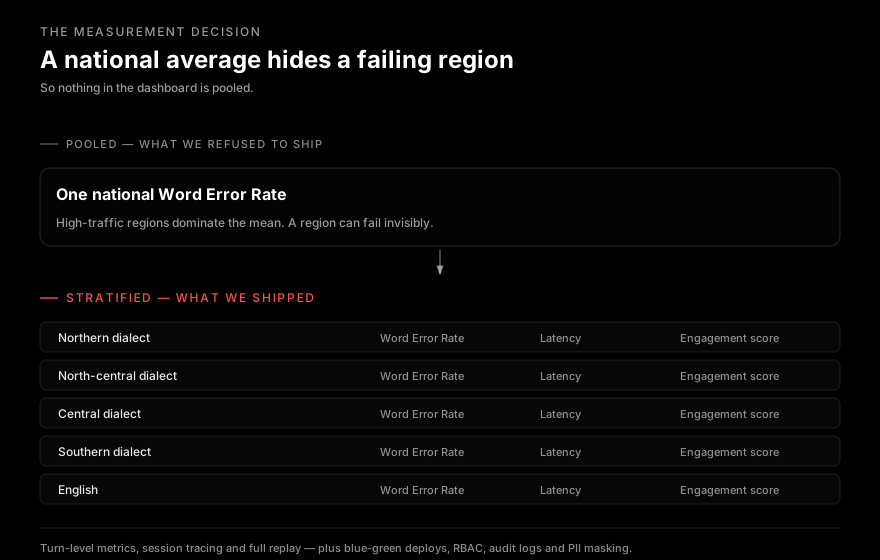
- DialectPerformance reported as a single national average would hide entire regions failing underneath it, because high-traffic regions dominate the mean.
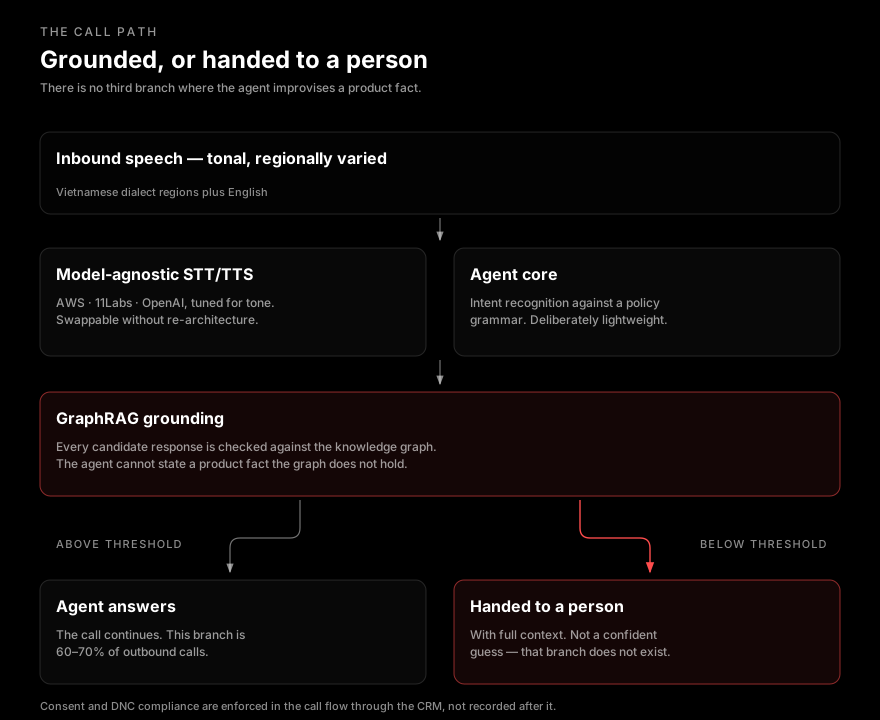
- GroundingAn agent that improvises a product fact during a sales call is a compliance problem, not merely a quality one.
- Vendor riskCommitting to one speech provider in a fast-moving market would have forced a re-architecture within the year.
- RegulatoryOutbound calling carries consent and Do-Not-Call obligations the system has to enforce, not merely record after the fact.
Our approach
Ground the agent, then make the model swappable
Two decisions did most of the work. Everything the agent says is grounded in a knowledge graph, and no part of the stack is committed to a single model vendor.
The first is a correctness decision: in an outbound sales context, a hallucinated product fact is a regulatory exposure. The second is a longevity decision — speech models were changing fast enough that a hard dependency on one provider would have dated the system within months.
The solution
A GraphRAG-enhanced voice platform
- Model-agnostic voice kit — Plug-and-play across AWS, ElevenLabs, Soniox and OpenAI speech providers, tuned for Vietnamese tonal nuance. Models swap without re-architecture.
- Conversation grounding — GraphRAG over interconnected knowledge graphs. Every candidate response is checked against the graph, so the agent cannot state a product fact the graph does not hold.
- Agent core — A deliberately lightweight LLM system handling intent recognition and policy grammar, with confidence thresholds driving handoff.
- Accent-stratified monitoring — Word Error Rate, latency and engagement, reported per dialect region rather than pooled into one number.
- Enterprise integration — ODOO CRM connectors for lead updates, call logging, consent management and DNC compliance — inside the call flow.
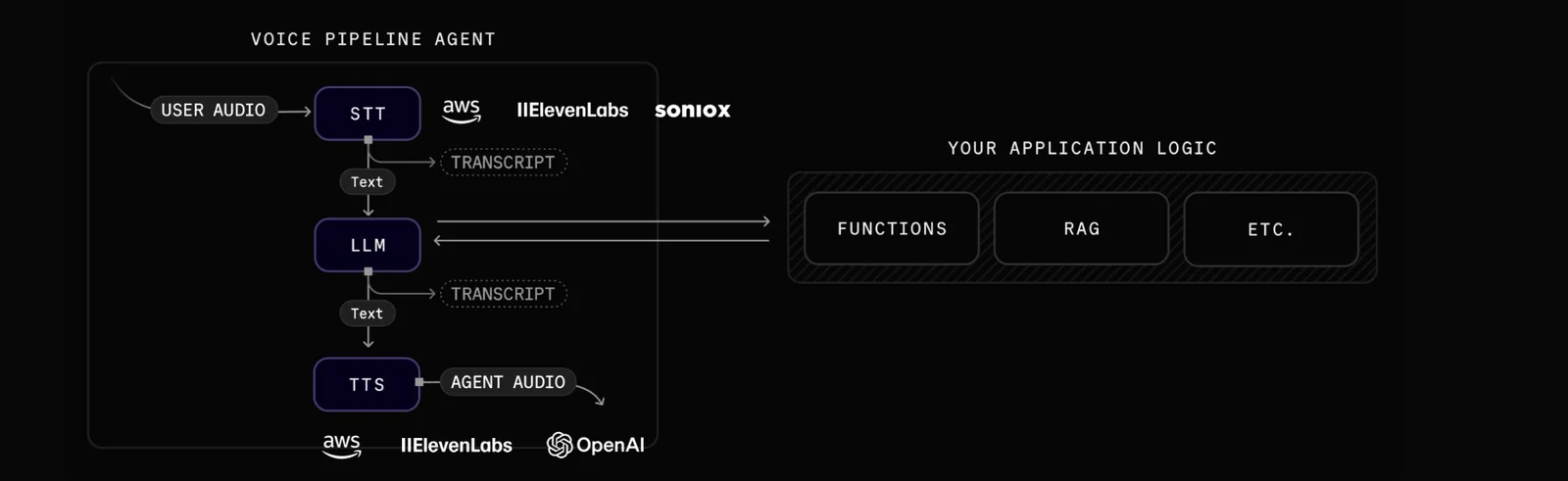
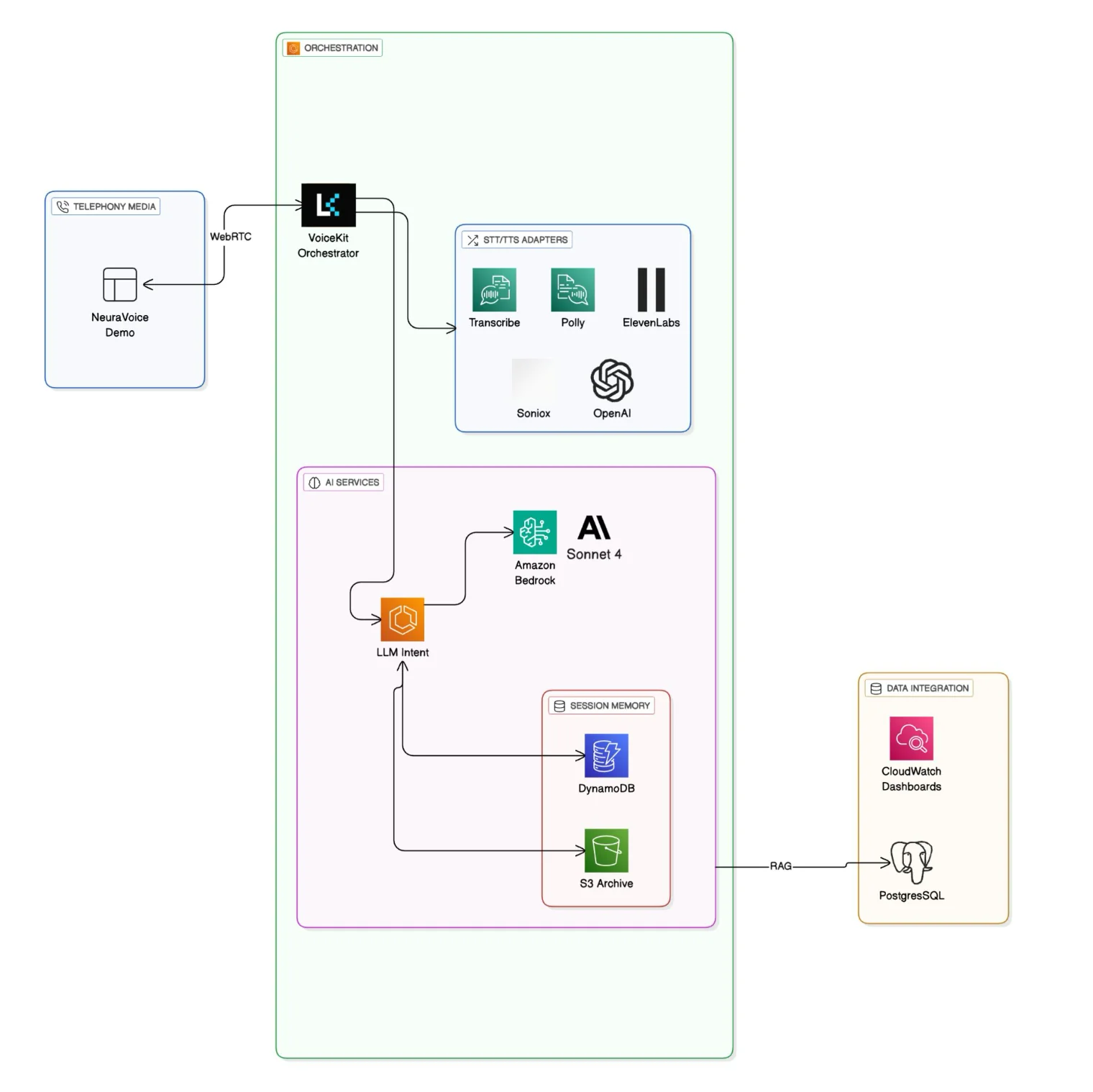
Architecturally: Live Kit Voice with LLM intent recognition and tools, running an Understand-Resolve-Confirm interaction framework. Blue-green deployments with shadow testing. RBAC, audit logs and PII masking. Auto-scaling infrastructure with intelligent cost management through model switching.
Responsible by design
Four properties that are structural, not prompted
Ground
The agent cannot state a fact the graph does not hold.
Enforced structurally through GraphRAG rather than by instructing the model to be careful.
Escalate
Below threshold, a person takes the call.
There is no third branch where the agent improvises. The uncertain case routes to a human with full context.
Stratify
Nothing in the dashboard is a national average.
A pooled Word Error Rate lets a dialect region fail invisibly behind higher-traffic regions.
Enforce
Consent and DNC live in the call flow, not the audit log.
Compliance recorded after the fact is compliance you have already breached.
The escalation branch is the one that decides whether this system is safe. A voice agent that answers everything will answer wrongly some of the time, in a medium where the customer cannot see a confidence score. Confidence thresholds mean the uncertain call becomes a handoff rather than a confident guess.
Results
Measured across the proof of concept
- 60–70% of outbound telemarketing calls automated, with quality held through confidence-threshold escalation rather than by lowering the bar.
- 50–60% reduction in time-to-conversion, for lead qualification and product consultation, measured during the proof-of-concept phase.
- Under 2 days to configure a new product or language, through reusable integration patterns rather than bespoke build.
Operational and governance
Beyond the numbers
What else changed
The model-agnostic architecture means models can be hot-swapped as the field moves — without re-architecting, and without renegotiating the accuracy baseline every time a provider ships a new version.
Governance came with it: compliance enforcement, data retention policy and proactive security testing, plus intelligent model switching that delivered measurable cost reduction alongside the quality gains rather than trading against them.
Both headline figures are ranges from a proof-of-concept phase, and we report them that way deliberately. The 60–70% automation and 50–60% conversion-time reduction were measured on the pilot corpus, not claimed for the full production call volume.
If your voice automation works in one accent and not the others
It is usually visible immediately once the metrics are stratified — and invisible for as long as they are pooled.